
China offers a broad manufacturing base for Silicone Decorative Molds, from detailed fondant designs to architectural plaster patterns. However, choosing the best manufacturer requires more than comparing catalog photographs, quoted prices, or the number of designs available for immediate purchase. Details matter. A shallow floral mold may release easily, while a deep ornamental design can tear during repeated demolding. Buyers should examine edge definition, cavity depth, surface finish, and the flexibility needed for their specific casting material. These practical differences help explain why two molds that appear nearly identical online can perform very differently during everyday production and cleaning.
A useful manufacturer assessment starts with material specifications, sample consistency, tooling capabilities, and clear communication about intended applications. Ask for evidence. For food-contact applications, request documentation relevant to the destination market and confirm that it covers the actual silicone formulation being offered. A generic certificate is insufficient when its product description, test conditions, or issuing laboratory cannot be verified against the proposed order. For resin, wax, or plaster work, check compatibility and operating temperatures. Request samples with narrow grooves, thin borders, and recessed lettering.
Custom production introduces another set of questions about design ownership, prototype revisions, minimum quantities, and replacement tooling costs over the expected purchasing period. Written specifications make these discussions easier. Still, a good sample does not guarantee a consistent production batch. That uncertainty deserves attention. Comparing manufacturers through documented capabilities, representative samples, and agreed inspection criteria provides a more credible basis for selection than treating any supplier ranking as definitive. The strongest choice should fit your application, budget, and quality requirements.
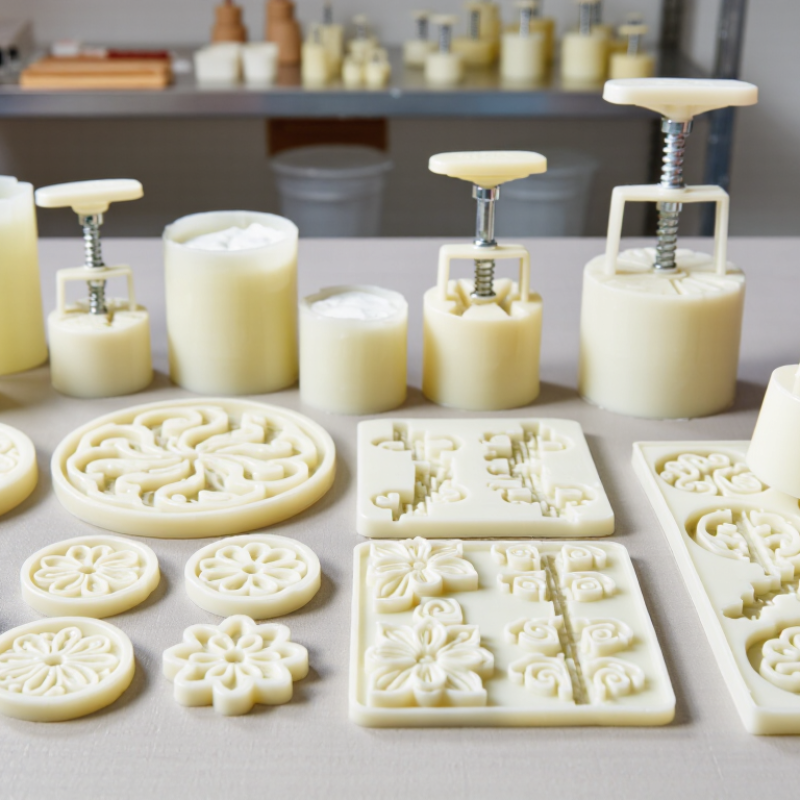
Silicone decorative molds reproduce details such as rose petals, geometric grooves, lace borders, and raised lettering. Common types include flat relief molds, deep cavity molds, and two-part molds for freestanding shapes. A shallow floral mold suits furniture appliqués, while deeper cavities accommodate candle designs or small plaster ornaments. Undercuts need flexibility. However, very soft silicone can distort during pouring, especially around thin walls or unsupported edges.
Material selection depends on the casting medium and the surface finish you need. Platinum-cured silicone generally offers low shrinkage and good dimensional stability when processed correctly. Tin-cured silicone can suit decorative casting, although shrinkage and service life vary with formulation and use. Shore A hardness helps compare flexibility, but tear strength also matters around narrow petals and intricate openings. Check compatibility first. Some casting materials or surface contaminants can inhibit curing, so a small trial helps prevent wasted batches. Food-contact applications require suitable grades and documentation for the intended conditions; appearance alone proves nothing.
When evaluating manufacturers in China, request samples that match your actual design complexity and casting material. Inspect cavity surfaces for pinholes, uneven textures, and thin sections that could tear during demolding. Ask for dimensional tolerances, recommended processing temperatures, and material traceability records. A flawless sample deserves repeated casting trials, because one successful release says little about durability. Choosing the softest sample may seem sensible, but delicate details sometimes need firmer support.
Guangdong is a practical starting point when sourcing silicone decorative molds in China. Dongguan, Shenzhen, and nearby manufacturing centers offer access to silicone processing, tooling, and packaging suppliers. This proximity can simplify development for floral reliefs, textured panels, and small ornamental shapes. Details matter. Ask suppliers how they control bubbles, thin edges, and distortion during demolding. A sample with crisp petal veins provides more useful evidence than a polished factory brochure.
Zhejiang offers another sourcing base, particularly around Ningbo and the wider Yiwu trading network. Buyers can explore decorative molds for candles, plaster ornaments, and resin crafts through manufacturers and trading companies. Check the distinction. A trading address does not establish where production happens or who controls quality. Request the actual factory location, material specifications, and samples from the proposed production process. Jiangsu also deserves consideration when searching for silicone processors capable of custom work, although decorative mold specialization requires verification.
Regional reputation alone is an imperfect buying guide, and an attractive sample can still hide inconsistent production. Compare molds using the same casting material, curing conditions, and inspection method. Examine seam placement, wall thickness, flexibility, and surface finish after repeated use. Intricate undercuts may require softer silicone, but excessive softness can reduce dimensional stability. Tooling sometimes needs revision; that possibility should be reflected in the sampling schedule and written quotation.
Leading silicone decorative mold manufacturers in China should be assessed through samples, production controls, and clear material specifications. A polished catalog reveals little about how a mold performs after repeated casting. Details matter. For floral reliefs, check petal edges, recessed veins, and the consistency of cavity depth. On geometric panels, inspect corner sharpness and whether thin walls bend during filling. Request samples made with your intended casting material, such as plaster, wax, or resin.
Material selection deserves equal attention because silicone hardness, tear strength, and curing chemistry affect release performance and service life. Softer silicone can simplify demolding intricate shapes, but unsupported walls may distort under heavier pours. Harder silicone holds dimensions better, although delicate undercuts can become difficult to release. Test before ordering. Ask manufacturers to identify the silicone grade and provide relevant technical data sheets. Where food contact is intended, request documentation applicable to the destination market and intended use. A generic certificate alone cannot establish suitability for every application.
Reliable production also depends on repeatable tooling, controlled curing, and inspection records tied to individual batches. Discuss acceptable bubbles, dimensional tolerances, and seam placement before approving a production sample. Small seams may be unavoidable, and removing every visible mark can increase finishing costs. That tradeoff deserves discussion rather than an automatic rejection. For custom designs, confirm ownership terms, revision charges, sample approval procedures, and replacement arrangements for defective molds.
Understanding the silicone base material provides useful context when evaluating decorative molds. The chart below shows the calculated elemental composition of the ideal polydimethylsiloxane (PDMS) repeating unit, a common base polymer in silicone mold materials.
Silicon and oxygen form the polymer backbone, while methyl groups contain carbon and hydrogen. These percentages are calculated from the repeating-unit formula [SiO(CH₃)₂] and standard atomic weights. Finished decorative molds also contain formulation-dependent ingredients, so their measured composition will differ. These figures describe the ideal base polymer and do not represent manufacturer performance or product rankings.
Calculation basis: C₂H₆OSi; atomic weights used: C = 12.011, H = 1.008, O = 15.999, Si = 28.085. Reference: CIAAW Abridged Standard Atomic Weights. Values are rounded to two decimal places.
China’s strongest silicone decorative mold manufacturers should be compared through documented quality, customization capability, and verified production capacity. UNIDO’s International Yearbook of Industrial Statistics 2024 places China at roughly one-third of global manufacturing value added. That scale supports supplier choice, but says little about an individual factory’s consistency. Ask for evidence. For decorative molds, inspect cured samples for trapped bubbles, uneven walls, surface residue, and distorted edges. Compare tear-strength results using the same test method, rather than accepting an unsupported “premium silicone” description.
Customization deserves closer scrutiny than a catalog of available shapes. Send identical drawings to shortlisted factories, specifying cavity dimensions, relief depth, surface finish, and acceptable dimensional variation. A 1 mm floral vein, for example, tests detail reproduction differently from a broad geometric pattern. Request a prototype before approving production tooling. Check revision charges. Lower tooling prices can become expensive when suppliers charge separately for every adjustment. Hardness also involves compromise: softer silicone releases intricate shapes easily, while thin sections may need greater tear resistance.
Production capacity should reflect your actual mold design, rather than a factory’s largest advertised monthly figure. Request a capacity calculation covering cavity count, curing time, inspection losses, and available shifts. Ask whether quoted lead times include prototype approval and packaging. A convincing sample still leaves uncertainty about repeat orders. A small pilot batch helps reveal inconsistent curing, trimming defects, and packing damage before a larger commitment.
A process-based sourcing guide for comparing anonymous supplier profiles for decorative silicone molds, including baking decorations, fondant details, resin ornaments, candles, and plaster castings.
| Manufacturer Profile | Suitable Decorative Mold Applications | Quality Factors to Compare | Customization Capabilities to Confirm | Production Capacity Considerations | Evidence to Request |
|---|---|---|---|---|---|
| Platinum-Cure Silicone Casting Specialist Addition-cure casting | Detailed decorative cavities, resin ornament molds, and food-contact decorative molds when the finished product meets the applicable requirements. | Addition-cure silicone generally has low cure shrinkage. Check detail reproduction, complete curing, tear resistance, and compatibility with the master model. Certain contaminants and master materials can inhibit curing. | Bespoke shapes, textured masters, cavity layouts, mold splits, and a choice of available hardness grades. Confirm whether master preparation and vacuum degassing are performed in-house. | Output depends on the number of masters, available casting stations, working time, and cure schedule. Increasing the number of masters can expand parallel production. | Silicone technical data sheet, approved samples, master-material compatibility checks, dimensional inspection results, and application-specific test reports where required. |
| Tin-Cure Silicone Casting Specialist Condensation-cure casting | Decorative plaster castings, craft prototypes, and resin or wax molds where the selected silicone is compatible with the casting material. | Condensation curing releases by-products, and cure shrinkage can affect dimensional accuracy. Check dimensions after the specified cure period, surface condition, and resistance to repeated casting. | Custom master replication, split molds, cavity arrangements, and available hardness options. Verify the achievable tolerance for fine decorative features. | Capacity depends on casting labor, master availability, cure time, and finishing work. Obtain output figures for the proposed mold design and actual production setup. | Material specifications, cure instructions, dimensional samples, and repeated-casting results using the intended resin, wax, or plaster. |
| Compression-Molded Silicone Manufacturer Heated compression tooling | Repeat-order silicone mold trays, decorative baking cavities, fondant molds, and standardized craft mold designs suitable for compression tooling. | Check flash, parting lines, cavity filling, thickness consistency, cure control, and dimensional repeatability. Demolding performance depends on both silicone properties and product geometry. | Custom metal tooling, embossed or debossed details, pigments, cavity counts, and product dimensions. Tooling changes may be needed for later design revisions. | Output is governed by press availability, cavities per tool, molding cycle, loading and unloading time, trimming, and accepted yield. | Tool drawings, first-article samples, inspection records, available press specifications, cycle-time evidence, and a production plan for the requested order. |
| Liquid Silicone Rubber Injection Manufacturer LSR injection molding | Repeat designs that justify injection tooling, including silicone mold components and decorative mold products whose geometry allows reliable automated molding. | Metering accuracy, mixing, venting, mold temperature, and tooling precision affect consistency. Inspect for flash, trapped air, incomplete filling, and damage during removal from the tool. | Precision cavities, surface textures, custom colors, and automation-compatible geometry. Confirm whether the product can be demolded reliably from the proposed tool. | Automation can support repeat production. Actual output depends on machine allocation, cavity count, cure cycle, demolding method, uptime, and yield. | Manufacturability review, tooling proposal, trial-run samples, process-control records, and demonstrated output for a comparable part or the proposed tool. |
| Prototype and Small-Batch Silicone Mold Workshop Master-based development | Original sculpted decorations, seasonal designs, sample collections, and products requiring several design revisions before repeat production. | Final surface quality depends on the master and its preparation. Visible print layers, tool marks, or sculpting defects can transfer to the silicone cavity. | Master-model development, dimensional adjustments, cavity changes, split-line trials, and sample iterations. Confirm design-file ownership and revision charges. | Capacity is typically constrained by master preparation, manual work, and curing space. Confirm how the approved prototype will be reproduced at the required order volume. | Approved master, revision history, signed reference sample, small-batch inspection results, and a documented scale-up proposal. |
How to compare quality: Give each candidate the same drawing, casting material, intended use, and acceptance criteria. Compare cavity dimensions, surface defects, demolding behavior, and service life under the same test conditions. Silicone cure chemistry alone does not establish finished-product quality.
How to compare capacity: Request accepted units per working day for your specific design. A useful planning estimate is: cavities per tool × cycles per hour × scheduled production hours × uptime factor × accepted yield. For cast molds, also account for the number of masters and occupied cure stations. No numerical capacity, minimum order quantity, or lead time is stated here because these require supplier-specific evidence.
Food-contact verification: “Platinum-cure” and “food-grade” labels alone do not establish compliance. Request documentation covering the finished formulation, including pigments and additives, and the intended temperature, contact time, and food types. Applicable references may include 21 CFR 177.2600 for repeated-use rubber articles in the United States and Regulation (EC) No 1935/2004 for food-contact materials in the European Union, together with applicable national requirements.
Selection principle: Choose the manufacturing profile that fits the mold geometry, required consistency, customization needs, and verified order capacity. These profiles can overlap within one factory; confirm the actual production process before comparing quotations.
Finding the best silicone decorative mold manufacturers in China requires evidence beyond polished catalog photos. The ISO Survey 2022 recorded over 1.26 million ISO 9001 certificates worldwide. That figure reflects widespread quality-system certification; it does not establish any supplier’s mold quality. Verify the certificate’s validity, manufacturing address, and scope through its issuing certification body. Request a business license and a live factory walkthrough showing mixing, vacuum degassing, and curing equipment. Ask who makes tooling. Outsourced production deserves the same scrutiny.
Order samples with thin petals, deep lettering, and narrow corners to expose filling and demolding problems. Test with your intended casting material, following its processing instructions. Inspect trapped bubbles, torn edges, surface residue, and distortion against an approved drawing. Measure critical dimensions after curing, since shrinkage varies with material and processing conditions. Repeat ten casting cycles as an initial screen, recording release effort and visible damage after each cycle. Ten cycles cannot establish the mold’s full service life. Keep one untouched.
Request a technical data sheet specifying Shore A hardness, tear strength, and the recommended temperature range. ASTM D2240 and ASTM D624 provide recognized methods for hardness and tear testing, respectively. Compare results only when test methods and conditions match. A supplier’s impressive tear-strength figure may describe a laboratory specimen rather than your finished mold. Before ordering, agree on dimensional tolerances, acceptable surface defects, and remedies for rejected batches in writing. Require production material and curing conditions to match the approved sample.