
A Vtol Fixed Wing Drone promises two useful things: vertical takeoff from a compact site and efficient forward flight across longer routes. That combination sounds simple. In practice, it depends on careful engineering. Transition control, payload capacity, endurance, wind tolerance, and landing reliability all shape real-world performance. A smooth demonstration is not enough; buyers need evidence from repeatable missions and clear operating data.
A useful aviation-design maxim comes from Kelly Johnson, the renowned aerospace engineer: “Keep it simple, stupid.” It is a fitting test for any shortlist. Does the aircraft launch consistently? Can operators inspect its motors, control surfaces, batteries, and software without guesswork? The following guide compares ten VTOL fixed-wing platforms for global buyers, focusing on practical specifications, mission fit, support, and room for growth. Product details can change, and published flight times rarely reflect every payload or weather condition. Check the fine print. No ranking is flawless; local service and training may matter more than one extra minute aloft. Use the list as a starting point, then verify each aircraft against your terrain, workflow, and procurement requirements.
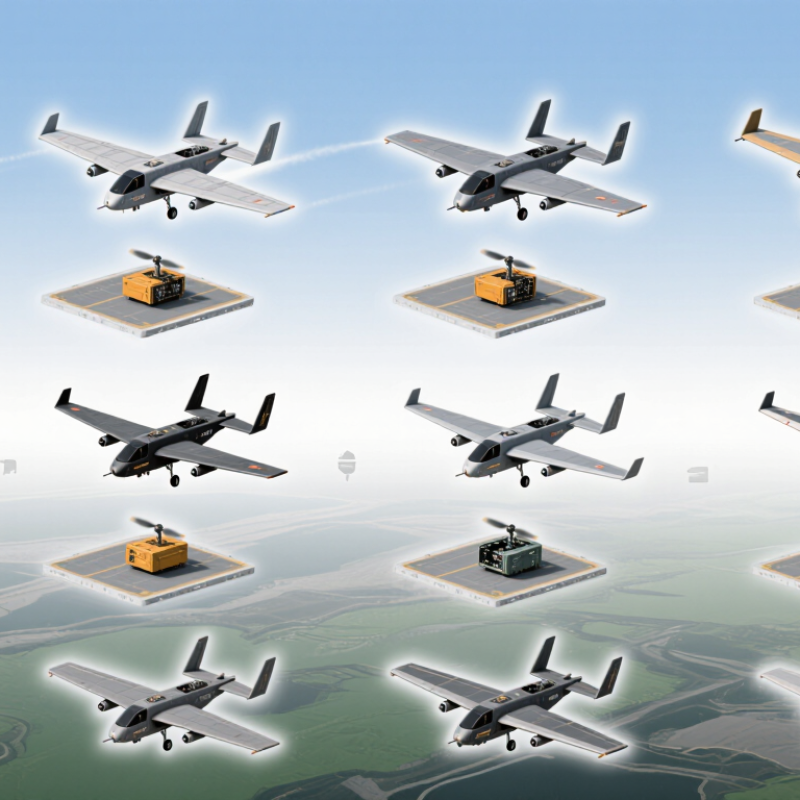
A VTOL fixed-wing drone combines two useful flight modes. Lift motors raise it vertically, so it can launch from a compact clearing without a runway. Once airborne, it transitions to forward flight, where its wings provide lift and usually require less power than hovering. The changeover is a critical phase: airspeed, wind, payload, and control settings all affect stability. Small details matter.
Tips: Check the planned transition area for trees, wires, and gusty crosswinds. Confirm the aircraft’s takeoff mass and battery condition before flight. Leave room for a safe landing; return distance can grow when wind shifts.
Efficient cruise comes from the wing carrying most of the aircraft’s weight, not from speed alone. A steady pace can extend useful coverage, while aggressive turns or a heavy sensor payload may reduce endurance. Operators should compare manufacturer performance figures with realistic conditions, including temperature and altitude. A short test flight with the intended payload can reveal differences that a specification sheet cannot. There is no perfect setting for every mission. Even careful planning may need adjustment when the wind changes or the landing surface proves uneven. Keep clear flight logs, and review them before repeating the route.
A useful top-10 comparison starts with payload, but payload figures need context. Check whether the stated capacity includes cameras, batteries, and mounting hardware. Compare it with maximum takeoff weight (MTOW), not in isolation. Under FAA Part 107, a small unmanned aircraft weighs less than 55 pounds, including everything onboard at takeoff. That threshold is a regulatory category, not a measure of aircraft quality or mission capability.
Endurance should be compared at a stated payload; an empty-airframe flight time can mislead. Ask whether the figure comes from still-air testing and note the battery reserve. Range also needs a clear definition: control-link distance, planned route length, and return distance are not interchangeable. Wind limits deserve equal scrutiny. Look for separate sustained-wind and gust limits, plus the test conditions. A single number may conceal real operating constraints. That shortcut is imperfect. The FAA’s 2024 Aerospace Forecast projects the U.S. commercial small-UAS fleet could approach 858,000 by 2028, underscoring the growing range of mission needs. For each candidate, record payload, endurance under load, usable range, MTOW, and wind limits in one table. Include the source and test conditions. A tidy comparison can still hide gaps. Probe those gaps before ranking.
For U.S. buyers, FAA Part 107 generally covers small unmanned aircraft weighing less than 55 pounds at takeoff. That limit includes attached equipment and payload, not just the empty airframe. A VTOL fixed-wing drone may gain weight quickly when fitted with a larger battery, mapping camera, or extra sensor. Small details matter.
Compare each aircraft’s stated weight with its intended operating configuration. Place the fully equipped drone on a calibrated scale, including batteries and installed accessories. A catalog figure can be misleading. Operators must also check applicable pilot qualifications, registration, airspace requirements, and operating rules. Requirements can depend on the flight and location, so verify current FAA guidance before choosing a platform.
Part 107 is a U.S. framework, not a global approval. Buyers operating elsewhere should consult that country’s aviation regulator and confirm local requirements before purchase. This matters when a drone is near the weight threshold; local categories may differ. Paperwork is less exciting than flight testing, but overlooking it can disrupt a project. Even careful planning leaves room for surprises.
The entries below are generic aircraft classes, not specific products. Performance figures are indicative planning ranges for VTOL fixed-wing designs; actual results vary with configuration, payload, weather, battery or fuel, and operating procedures.
| # | VTOL Fixed-Wing Class | Typical Maximum Takeoff Weight | Indicative Endurance | Typical Payload Capacity | Common Applications | FAA Part 107 Weight-Threshold Fit | Buyer Considerations |
|---|---|---|---|---|---|---|---|
| 1 | Micro mapping VTOL | 3–8 kg (6.6–17.6 lb) | About 1–2 hours | About 0.2–0.8 kg | Small-site mapping, inspection, and training | Below threshold | Prioritize portability, quick setup, and straightforward field repairs. |
| 2 | Compact survey VTOL | 5–12 kg (11.0–26.5 lb) | About 1.5–3 hours | About 0.5–1.5 kg | Land surveying, construction progress, and corridor mapping | Below threshold | Check payload mounting options, ground-control workflow, and battery availability. |
| 3 | Photogrammetry VTOL | 8–18 kg (17.6–39.7 lb) | About 2–4 hours | About 0.5–2 kg | Orthomosaic production, topographic surveys, and site documentation | Below threshold | Assess camera integration, image geotagging, and required ground sampling distance. |
| 4 | Utility inspection VTOL | 12–22 kg (26.5–48.5 lb) | About 2–5 hours | About 1–3 kg | Power-line, pipeline, and infrastructure inspection | Below threshold | Confirm sensor compatibility, electromagnetic environment limits, and safe operating procedures. |
| 5 | Long-endurance lightweight VTOL | 15–24.9 kg (33.1–54.9 lb) | About 4–8 hours | About 0.5–2 kg | Wide-area mapping, environmental monitoring, and extended observation | Below threshold if configured under 55 lb | Include the aircraft, payload, and other applicable components when checking takeoff weight. |
| 6 | Medium-payload industrial VTOL | 18–30 kg (39.7–66.1 lb) | About 2–5 hours | About 2–5 kg | Multisensor inspection, agriculture, and industrial data collection | Configuration-dependent | Some configurations exceed the Part 107 small-UAS weight limit; verify the actual takeoff weight. |
| 7 | Heavy-payload VTOL | 20–35 kg (44.1–77.2 lb) | About 1.5–4 hours | About 3–8 kg | Specialist sensor transport and heavier inspection payloads | Often exceeds threshold | Payload capacity can push takeoff weight above 55 lb; assess the applicable operating rules before purchase. |
| 8 | Maritime and coastal survey VTOL | 10–22 kg (22.0–48.5 lb) | About 2–5 hours | About 0.5–2 kg | Coastal mapping, shoreline monitoring, and marine observation | Below threshold | Consider corrosion protection, wind tolerance, launch-site conditions, and recovery planning. |
| 9 | Modular multi-sensor VTOL | 15–24.9 kg (33.1–54.9 lb) | About 2–6 hours | About 1–4 kg | Projects requiring interchangeable cameras, mapping sensors, or inspection payloads | Below threshold if configured under 55 lb | Confirm that each payload configuration remains within the stated weight and balance limits. |
| 10 | Fuel-assisted long-endurance VTOL | 20–40 kg (44.1–88.2 lb) | About 4–10 hours | About 1–5 kg | Extended-area monitoring and missions where longer flight time is important | Frequently above threshold | Fuel systems add operational and maintenance requirements; confirm weight, noise, and local rules. |
FAA Part 107 generally applies to small unmanned aircraft weighing less than 55 lb (24.9 kg) at takeoff, including everything onboard or attached. Meeting this weight criterion alone does not establish permission to fly: registration, Remote Pilot requirements, airspace authorization, visual-line-of-sight rules, and other applicable requirements still matter. Rules differ by country, so buyers should verify local regulations and the aircraft’s configured takeoff weight before operation.
For U.S. small-drone operations, Part 107 generally caps altitude at 400 feet above ground level and groundspeed at 87 knots, or 100 mph. These figures come from 14 CFR §107.51, not a promise that every aircraft can safely reach them. The rule allows limited altitude above a structure when operating close to it. Buyers outside the United States should check local rules; Part 107 is not a global standard.
A VTOL fixed-wing aircraft must transition from vertical lift to forward flight, using energy and clear airspace along the way. Wind, payload, and battery condition can reduce practical range well before the legal ceiling matters. The FAA’s Aerospace Forecast for fiscal years 2024–2044 tracks growth in the commercial small-UAS fleet, making disciplined operating plans increasingly important. Still, a forecast cannot tell you how a specific aircraft handles a gust beside a tree line.
Tips: Treat 400 feet and 100 mph as hard boundaries, not mission targets. Check local airspace, log wind and battery readings, and leave room for a safe return. I would keep extra margin. That part is easy to underestimate.
Global buyers should rank VTOL fixed-wing drones by mission fit, not headline range. The FAA’s 2024 Aerospace Forecast projects the U.S. commercial small-drone fleet could approach 955,000 aircraft by 2034. That forecast covers small drones broadly, not VTOL models alone. Still, it signals growing demand for practical, repeatable workflows.
For mapping, the strongest matches are long-endurance survey aircraft, RTK-equipped survey platforms, multispectral configurations, and compact low-altitude models. They suit broad terrain, control-point checks, crop analysis, and tight sites, respectively. For inspection, prioritize corridor-optimized aircraft, thermal-payload configurations, and high-wind platforms. These better fit linear assets, heat anomalies, and exposed structures. For response, rank rapid-deployment models, heavy-payload platforms, and communications-relay configurations. The first favors quick launches; the second supports useful sensors; the third can extend coverage when ground links are weak. Payload weight and wind tolerance can overturn this ranking.
PwC’s 2016 report estimated a $127.3 billion potential market for drone-powered solutions by 2020. That was a forecast, not a measured result, and should not be treated as current market size. Buyers should test actual flight time with their chosen sensor, then verify image overlap, landing clearance, and data quality on a small site. A published endurance figure may not survive a cold morning, a headwind, or a heavier camera. We sometimes overvalue range. Mission logs matter more.