Why Choose Material Handling Carts for Your Business?
Warehouses rarely lose time in dramatic moments. They lose it through repeated walking, awkward lifting, and poorly staged materials. Material handling carts can shorten these small delays. A well-selected cart moves bins, tools, cartons, or components directly to the workstation. Its value becomes visible on the floor: fewer trips, clearer aisles, and smoother replenishment.
The MHI 2024 Annual Industry Report identifies labor availability, productivity, and supply chain resilience as continuing priorities for logistics leaders. Those pressures make simple material flow improvements more important. The U.S. Bureau of Labor Statistics also continues to recognize transportation and material-moving work as physically demanding. A cart cannot remove every ergonomic risk. However, it can support better handling practices when its capacity, wheel design, handle height, and route suitability are evaluated properly. That distinction matters.
Small changes count.
In a manufacturing cell, an operator may push a loaded cart twelve meters instead of carrying separate containers by hand. In a hotel, housekeeping staff may move linens, supplies, and waste in one organized trip. In a distribution center, modular carts can support picking and temporary staging without requiring powered equipment. These examples reflect practical experience, not a guarantee. Overloading, poor maintenance, narrow aisles, or unsuitable casters can create new problems. I would not choose a cart from price alone. The better decision considers load weight, floor conditions, turning space, cleaning requirements, and employee feedback. Used thoughtfully, material handling carts offer a comparatively simple way to improve daily movement, workplace organization, and operational consistency.
What Are Material Handling Carts?
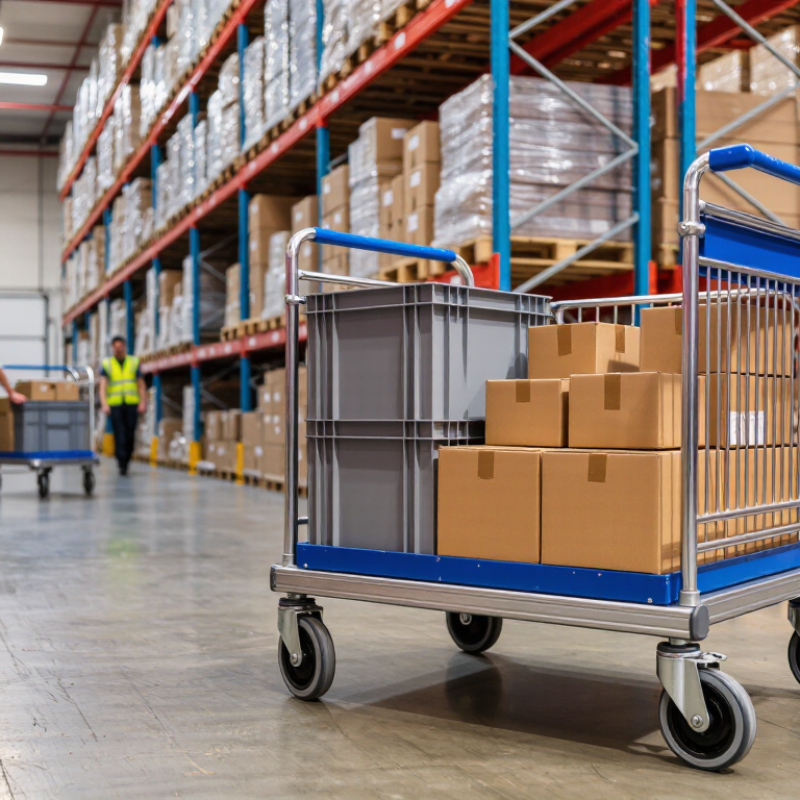
Material handling carts are wheeled tools used to move products, parts, tools, and waste inside a workplace. They usually include a steel or polymer frame, shelves, platforms, handles, and casters. Workers push them between storage racks, assembly stations, loading areas, and maintenance zones. Unlike powered vehicles, carts rely on controlled human movement. They are simple, visible, and often easier to deploy.
The market reflects their wider importance. Grand View Research valued the global material handling equipment market at approximately USD 213.7 billion in 2023. It also projects a 5.5% compound annual growth rate from 2024 to 2030. Material handling carts represent only one segment, but they support daily movement without complex charging systems. MHI’s 2024 Annual Industry Report also identifies labor availability and productivity as major supply chain pressures. A well-designed cart can reduce repeated carrying and shorten walking distances.
Small details matter. Large casters roll better over floor joints. A low center of gravity helps prevent tipping near corners. Brakes improve control during loading. Operators should test handle height, shelf reach, and turning space before purchase. A cart that looks efficient may become awkward when fully loaded. That assumption deserves questioning. In practice, poor wheel selection can create more pushing effort, noise, and worker fatigue. Load ratings should reflect real use, not an ideal demonstration.
Material handling carts support daily operations by moving tools, parts, and finished goods closer to the point of use. Workers spend less time walking between storage and workstations. They can also transport multiple items in one trip. That matters in busy warehouses, workshops, hospitals, and retail backrooms.
The U.S. Occupational Safety and Health Administration identifies lifting, pushing, and pulling as common ergonomic risk factors. A properly selected cart can reduce repeated carrying and improve load control.
The National Safety Council’s Injury Facts reports that overexertion remains a leading cause of workplace injuries. Carts do not remove every risk, but they can make safer movement easier.
Choose wheels for the floor surface, handles that support neutral posture, and a platform sized for real loads. Not theoretical ones.
Carts also support inventory accuracy and workflow visibility. A labeled cart can hold items for one order, repair task, or production stage. This reduces misplaced materials and unnecessary searching. The 2024 MHI Annual Industry Report found that 55% of supply chain professionals expected to increase technology investment. Yet basic equipment still matters. Digital systems cannot move a heavy component across a floor.
In practice, teams sometimes overload carts or leave them in aisles. That weakens their value and creates new hazards. Clear weight limits, inspection routines, and designated parking areas help maintain reliable operations. (Sources: OSHA, Ergonomics; National Safety Council, Injury Facts; MHI, 2024 Annual Industry Report)
Material handling carts can turn repeated lifting into controlled movement. They support picking, replenishment, assembly, and internal transport. The right cart depends on the load, route, and floor conditions. A platform cart suits boxed equipment and irregular loads. A shelf cart keeps small items separated during order picking. A bin cart improves visibility for parts and components. For long routes, a towable cart may reduce walking and repeated handling. MHI’s 2024 Annual Industry Report identified workforce shortages as a major supply-chain concern, reported by 54% of respondents. Simple carts cannot solve labor gaps, but they can make each worker’s movement more productive.
Ergonomics also matters. The Liberty Mutual 2024 Workplace Safety Index reported that overexertion involving outside sources cost $12.7 billion in U.S. workplace injury costs in 2022. Choose carts with suitable handle heights, quiet casters, and brakes for sloped areas. Check turning space near racks. A narrow cart may work beautifully in one aisle and fail in another. That is an easy mistake. Load stability, visibility, and pushing force should be tested with real materials, not empty equipment.
Tips: Measure the narrowest route first. Test the cart at full working load. Keep heavier items between knee and waist height. Inspect wheels, frames, and brakes regularly. Record near misses, not only injuries. This may feel excessive, but small failures often appear before serious problems. A basic trial with operators can reveal awkward handles, blocked sightlines, or a cart that is simply too large.
| Cart Type | Typical Load Capacity* | Common Construction | Best-Fit Applications | Mobility Features | Key Advantages | Main Considerations |
|---|---|---|---|---|---|---|
| Platform Cart | 450–1,800 kg (1,000–4,000 lb) | Steel or aluminum frame with a solid deck | Moving boxes, machinery parts, containers, and bulky loads across warehouses or production areas | Two fixed wheels and two swivel casters are common; larger models may use four swivel casters | High capacity, stable deck, and flexible handling of large or irregular items | Requires adequate aisle width; load should be centered and secured |
| Platform Truck | 225–900 kg (500–2,000 lb) | Welded steel or aluminum platform, often with a push handle | General warehouse transport, maintenance work, shipping areas, and stockrooms | Swivel casters at the handle end improve turning and positioning | Simple design, broad utility, and quick loading from multiple sides | Open decks provide limited protection against items sliding off |
| Utility Cart | 90–450 kg (200–1,000 lb) | Steel, plastic, or composite shelves with one or two handles | Tools, supplies, order picking, janitorial work, and facility operations | Four swivel casters or two swivel and two rigid casters | Organizes small items and reduces repeated lifting and carrying | Shelf capacity and stability depend on load distribution |
| Wire Shelf Cart | 135–450 kg (300–1,000 lb) | Chrome-plated or coated wire shelves on a tubular frame | Kitchens, laboratories, healthcare areas, storerooms, and clean handling environments | Swivel casters, often with two locking brakes | Airflow, visibility, drainage, and easy cleaning around stored items | Small items may need bins or shelf liners to prevent falling through the wire grid |
| Bin Cart | 90–360 kg (200–800 lb) | Steel frame with removable plastic bins or containers | Small-parts storage, kitting, repair operations, and order fulfillment | Compact swivel casters support movement between workstations | Improves part visibility, sorting, and access at the point of use | Not intended for dense, oversized, or very heavy loads |
| Drum Handling Cart | 180–450 kg (400–1,000 lb), depending on drum size | Steel frame with drum cradle, chime hook, or retaining mechanism | Moving standard steel, plastic, or fiber drums containing liquids or materials | Large wheels or casters help cross thresholds and uneven industrial floors | Supports controlled handling and reduces manual lifting of cylindrical containers | The cart must match the drum diameter, weight, and contents; spill controls may be required |
| Pallet Positioning Cart | 450–1,800 kg (1,000–4,000 lb) | Heavy-duty steel frame with a pallet-compatible deck or supports | Short-distance movement of palletized goods in staging and production areas | Heavy-duty casters or wheels; some designs include brakes or tow points | Useful where powered equipment is unnecessary or aisle access is limited | Not a substitute for a forklift when loads must be lifted or stacked vertically |
| Lift Cart | 90–450 kg (200–1,000 lb) | Steel platform with hydraulic, pneumatic, or electric lift mechanism | Ergonomic height adjustment, machine loading, assembly, and workstation replenishment | Swivel casters with brakes; some powered models include drive assistance | Reduces bending and helps position loads at a safer working height | Higher purchase and maintenance costs; lifting capacity varies by platform height |
*Load capacities shown are common industry ranges for general-purpose carts. Actual capacity depends on the cart design, wheel or caster rating, deck configuration, floor conditions, and load distribution.
Why Choose Material Handling Carts for Your Business?
Benefits of Using Material Handling Carts
Material handling carts help teams move tools, parts, and finished goods with less lifting. In a busy warehouse, one cart can carry several boxes in a single trip. That saves walking time. It also reduces repeated bending, especially near low shelves. Workers can keep both hands near the load while steering. This feels simple. Yet simple changes often protect energy during long shifts. Swivel casters turn neatly around workstations and narrow aisles. Locking wheels add stability during loading. Still, wheel quality matters more than appearance. Uneven floors can expose weak frames and noisy bearings.
The right cart improves workflow without requiring new software or complex training. It can support picking, assembly, maintenance, laundry, or office deliveries. Shelves keep materials visible, while raised edges help prevent small items from sliding away. I have seen teams choose oversized carts, expecting flexibility, then struggle in crowded spaces. That choice deserves a second look. Measure doorways, aisle widths, turning areas, and typical load weights before buying. Match the cart to the work, not the other way around. Regular inspections also matter. Check handles, fasteners, wheels, and brakes before daily use. A damaged wheel can create more risk than the lifting it replaced. Clean surfaces help prevent residue from transferring between tasks. However, carts do not remove every handling hazard. Staff still need sensible loading habits, clear routes, and practical training. The best results come from observing real movement, then adjusting cart size, height, and storage position to fit the team.
Material handling carts help move heavier loads with less manual lifting, improve workflow organization, and support safer transport across warehouses, workshops, and production areas.
The chart compares typical rated load capacities for common non-powered cart types. Actual capacity depends on frame construction, wheel design, load distribution, and operating conditions.
Choosing a material handling cart starts with the load, not the price. Measure the heaviest item, its dimensions, and how often it moves. A cart rated for 500 pounds may fail when the load shifts or rolls. I have seen teams overlook doorway widths, turning space, and floor joints. Those small details later slow every delivery.
Check wheel type, handle height, platform material, and braking performance. Hard wheels suit smooth warehouse floors, while softer wheels reduce vibration on uneven surfaces. Swivel casters improve maneuverability, but they may feel less stable under tall loads. Match the cart to the route. Measure ramps and lift access too. Safety ratings should come from clear testing information, not vague claims. Consider cleaning needs, corrosion exposure, and noise limits. A basic cart may be enough. Buying too small often creates repeat work.
Tips: Mark the route with tape and test a loaded cart before ordering. Ask operators to push it, turn it, and stop it. Watch their posture. Record the results. It is easy to trust a specification sheet and miss real working conditions. Inspect welds, fasteners, wheel guards, and replacement-part availability. Standardize key parts where practical. This can reduce training time and simplify maintenance.